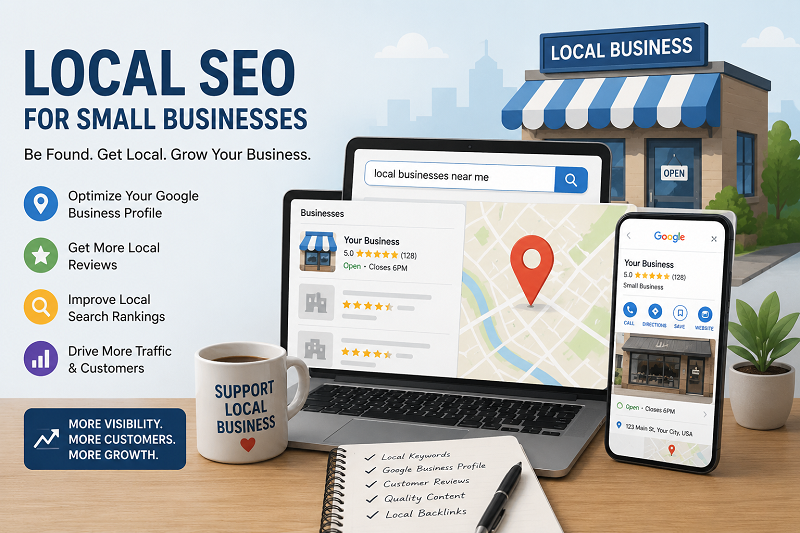
If you run a small business, you already know how much noise there is out there. Big brands with big budgets dominate search results, social media feeds are crowded, and it can feel like there's no room left for the local bakery, the neighborhood plumber, or the boutique fitness studio to get noticed. But here's the good news: you don't need a national ad campaign to win customers. You need to be visible to the people who are already looking for what you offer, right in your own backyard.
That's where local search comes in. When someone types "coffee shop near me" or "emergency electrician in [city]" into Google, they're not browsing — they're ready to buy, book, or visit. Showing up in those results, at the exact moment someone needs you, is one of the most cost-effective ways to grow a business. It doesn't require a massive marketing budget or a team of specialists. It requires consistency, a bit of strategy, and knowing where to focus your energy.
That's exactly what makes local SEO for small businesses so valuable. Unlike broad, national SEO campaigns that compete for generic keywords against thousands of websites, local search optimization narrows the playing field. You're not trying to outrank every business in the country — you're trying to be the obvious choice for people within driving distance of your storefront. That's a far more achievable goal, and it's one that pays off quickly when done right.
Start With Your Google Business Profile
If there's one thing every small business owner should prioritize first, it's their Google Business Profile (formerly Google My Business). This free listing is often the first thing a potential customer sees — it shows your hours, location, phone number, photos, and reviews before they even click through to your website. An incomplete or outdated profile can cost you a sale before the conversation even starts.
Make sure your business name, address, and phone number are accurate and consistent everywhere they appear online. Add high-quality photos of your storefront, products, or team. Choose the right business categories, and keep your hours updated, especially around holidays. This single step often makes the biggest difference of any local SEO effort, and it costs nothing but time.
Reviews Are Your New Word of Mouth
Before online reviews existed, word of mouth was everything. A neighbor's recommendation carried enormous weight. Today, reviews serve that same purpose, just at scale. A steady stream of positive, recent reviews signals to both search engines and potential customers that your business is active, trustworthy, and worth choosing.
Don't be afraid to ask satisfied customers to leave a review. Respond to every review you get, good or bad — it shows you're engaged and shows future customers how you handle feedback. A thoughtful response to a negative review can actually build more trust than a wall of five-star ratings with no interaction at all.
Get Your NAP Consistent Across the Web
NAP stands for Name, Address, and Phone number, and consistency here matters more than most business owners realize. If your business is listed as "Main St Bakery" on Google but "Main Street Bakery LLC" on Yelp and an old address on Facebook, search engines get confused about which information is correct. That confusion can hurt your rankings and, worse, send customers to the wrong location or an outdated phone number.
Take an afternoon to audit your listings across major directories — Yelp, Facebook, Bing Places, Apple Maps, and any industry-specific directories relevant to your field. Fixing inconsistencies is tedious but straightforward, and it's one of those behind-the-scenes tasks that quietly strengthens everything else you do.
Create Content That Speaks to Your Community
Search engines reward businesses that demonstrate genuine relevance to a location. That means your website shouldn't just say what you do — it should reflect where you do it. Write blog posts about local events you're sponsoring, neighborhood guides, or seasonal tips specific to your area. Mention nearby landmarks or neighborhoods naturally in your site copy.
This kind of content does double duty. It helps search engines understand your geographic relevance, and it helps real people feel like your business understands their community, not just their wallet.
Don't Overlook Mobile and On-Site Basics
A huge share of local searches happen on phones, often from someone standing outside deciding whether to walk in. If your website is slow to load, hard to navigate, or missing your address and phone number on the homepage, you're losing customers who were ready to act. Make sure your site loads quickly, displays clearly on mobile screens, and makes it effortless to find your location, hours, and a click-to-call button.
Building Momentum Over Time
Local search optimization isn't a one-and-done project — it's an ongoing habit. Update your listings periodically, keep gathering reviews, post fresh content, and monitor how you're showing up in search results over time. Small, consistent efforts compound. A business that spends thirty minutes a week on this will, over a year, dramatically outperform one that ignores it entirely.
The businesses that win locally aren't necessarily the biggest or the flashiest. They're the ones that show up, consistently and accurately, when someone nearby is searching for exactly what they offer. That visibility builds trust, and trust builds customers who come back again and again.
If managing all of this feels overwhelming on top of actually running your business, you're not alone — and you don't have to figure it out by trial and error. Yebble specializes in helping small businesses navigate exactly these kinds of challenges, turning local visibility into real, measurable growth without the guesswork.
Follow this link for another blog - Free SEO for small businesses